Wednesday, February 9, 2022

Typefaces based on tessellating patterns

 It has been more than nine months since I posted here. During that time I have been designing typefaces, investigating what is possible using the OpenType feature Contextual Alternatives (calt). There are few typefaces that use this feature to alternate two character sets, perhaps because the results appeal to a niche market and serious type designers have better uses of their time than to design for a minuscule market. I like the feature because it gives interesting results when there is a geometrical connection between the two character sets that are alternated. My first use of the feature was to alternate letter sets that were based on trapezoids.
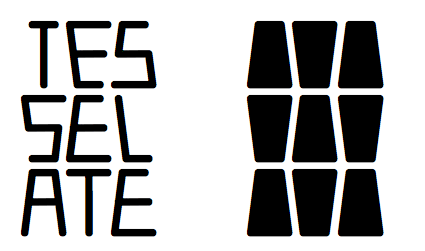

Notice that the trapezoids that serve as templates on which the letters are formed will tessellate. Tessellations were not on my mind when I designed this face. I was focused only on how the letters fit together in a word. However. I realized later that the template shape was part of a tessellation pattern, in the IH58 type. It can be constructed in several ways. The tops and bottoms can rotate 180º or flip to form neighbors. The sides can be C edges that rotate around their centers to form neighbors, or they can be considered glide edges. In terms of symbols, it could be CCCC, CGCG, CFCF, or GFGF. 

The typeface above did not exhaust the possibilities of trapezoidal letters, so I did a second family with a similar template but with letters that look very different.


Another trapezoidal shape that tessellates is formed by bisecting a regular hexagon. In this case I put the straight sides between letters and the interlocking part of the pattern on the top and bottom.

The trapezoid can be asymmetrical, as in the example below where the trapezoid was formed by cutting a rectangle into two equal parts with a slanted line. The pattern here can be formed by flipping the shape over the top and bottom and rotating it around the center of its sides. It fits the Grünbaum-Shepard IH49 classification. 


I followed up with letters formed with templates of rectangles and parallelograms that give a wave to a line of text. I did not think of tessellations when designing these, but the first template shape tessellates as a TCTC pattern (and also TGTG, CGCG, and G1G2G1G2) and belongs to the IH-66 class. In the second pattern, the tops and bottoms can be either center-point-rotation or translated edges and the sides can be either glided or flipped edges.


Using alternating characters one can design text that has a wave both horizontally and vertically. The template of the first of these is a IH-73 pattern (C4C4C4C4 at all corners, though it can also be formed as G1G1G2G2) and the second as an IH-71 pattern (fits both C4C4C4C4 and G1G2G1G2). The template shape in the second sample will tessellate in one orientation, two orientations, or four orientations. Only the four-orientation pattern is shown below.


Both of these typefaces are based on a template of distorted squares. 

I suspect a reason that I am willing to pursue this line of inquiry is because I like tessellations more than other type designers. No one else that I know of has designed multiple fonts from shapes that can form tessellation patterns.

For more information about these and other typefaces with alternating characters, see my type blog at nohyptype.blogspot.com

Tuesday, April 20, 2021

Grandpa's Amazing Tale: A Book of Mazes

It has been almost three years since I released Mazes Escher Would Like and after that book I did not expect to do another. There are so many maze books available that it is difficult to be seen. Also, the software I use is old and no longer runs on currently-available computers. And yet for some reason that I do not fully understand, in April of 2021 I decided to do one more.

As I was sorthing through old documents on my computer, I stumbled on an old story I had written.  I thought was funny and decided to illustrate it with mazes. Most of the mazes I used were old designs, but I did develop over twenty new maze designs for this book. 

Yes, I tessellated toilets and made a maze from the pattern. Below is another tessellation pattern I used.

The above maze would be trivial if displayed in a friendly typeface but it is one of the most difficult mazes in the book because it is so hard to follow the little passages that connect. It also posed a challenge for the way I construct mazes because the basic pattern is a grid of diamonds, so everything connects diagonally. 
The shape used above was also a challenge for my maze construction set. The basic shape is triangular, with one orientation adjacent to two above and the other with two below. I treated it as a maze of triangles and used two typefaces to render it.

Not everything is tessellation based. I used foot prints to form the walls of a maze that allows passages up and down, right and left, and diagonally.

The book is Grandpa's Amazing Tale: A Book of Mazes. It uses mazes to illustrate a silly story told by a grandparent to a granddaughter and involves time travel and dinosaurs, so it is both a story book and a puzzle book. It is intended for children in early elementary school.

It is published through Amazons's Kindle Direct Publishing and is available in paperback only at Amazon.

Friday, September 11, 2020

TessieSomeMore

In August I took a break for updating and creating alphabetic fonts to play with Tesselmanic! in an effort to create another tessellation font. With a lot of trial and error (mostly error), I was able to come up with over 40 designs that would fit into a typeface. I could not think of a clever name so settled for TessieSomeMore, indicating that it was a continuation of the Tessie series of fonts.

As I played with the various templates in Tesselmaniac!, I found that sometimes I would create something quite similar to what I had done in the past. One example is shape that resembles a butterfly. Below is the most recent version.

Looking through past efforts, I found something quite similar in TessieBugs. I kept the new version because it is so easily recognizable as an insect.
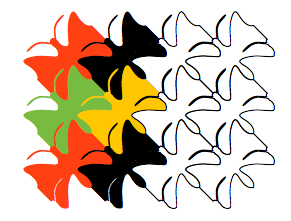
I noticed that if I added a straight segment where the wings touch, I could convert a tessellation that is IH68 to one that has six adjacent tiles and is type IH14.
Another insect design that resembles a past effort is this mite.
However, the old mite had six legs, so the new one is substantially different.
There are certain shapes that many people will stumble on if they play with tessellations enough.

Creating Escher-like pattern with the isohedral classification IH74 is challenging because there are not a lot of real-world objects that mirror both horizontally and vertically. Below is a stylized moth that fits the classification.
Again, the addition of a straight line where the wings touch turns it into a hexagonal figure. It retains all of its symmetry and is now IH17, another classification which is very difficult to use for Escher-like tessellations.
It is always exciting to find a new tessellating shape that is recognizable as an object. TessieSomeMore includes a shape recognizable as a toilet.

Another shape unlike any that I had previous found was one that resembles a creepy insect.
I tried to find interesting Escher-like tessellations in which the tile had two-fold rotational symmetry without mirror symmetry and came up empty. There are many real-world objects with reflective symmetry but very few with only rotational symmetry.
TessisSomeMore is available from myfonts. On the page linked, there is a link to a file that includes samples of all the patterns included in the typeface.

Friday, December 27, 2019

TessieLetters and an unusual alphabet

I have finally returned to and finished a series of TessieLetter typefaces that complement the eleven Tessie typefaces (here, here, here, and here) that allow one to create tessellation patterns of birds, animals, bugs, and variety of other shapes. TessieLetters is made up of seven different fonts (each in solid and outline styles) that contain all the letters of the alphabet as well as the numbers. You can find them at fontspring.com: here, here, here, here, here, here, and here and at myfonts here.

One of the seven in the series contains only shapes that can be tessellated using a single key. Somewhat surprisingly, I was able to find ways to do the complete alphabet in this way, though some of the letters require a bit of imagination. (U, T, and G are not ideal.) A breakthrough came when I figured out a way to form the letter P. The same shape works for lower-case b, d, q and letters 6 and 9. Below is a picture of the entire one-key tessellating alphabet.


All these patterns would fit as Heesch types TTTT or TTTTTT. Many have symmetry that would allow them to fit in other Heesch types as well. Also, for several letters (such as f, h, m, n, s, and z) there are multiple shapes that work.

I am unaware of anyone else who has constructed an alphabet with this property.

In the spirit of the season:


(Cross posted at nohypetype.blogspot.com)

Thursday, January 24, 2019

Tessellating Typefaces (part 4)

The addition of two more fonts of Escher-like tessellations at myfonts.com brings the total of the new tessie series to eleven. Four are of birds, one of other animals, one of bugs,  one of puzzle pieces, and four of everything else.

One of the recent additions is TessieBugs. It contains tessellating butterflies, moths, ants, and other creepy, crawly insects.

The other is TessieOddsNends, a hodgepodge of things that did not make it into any of the other ten faces.
Each contains two styles, a solid style that must be colored in order to see the shapes (after all, a tessellation fills the plane with no gaps or overlaps), and an outline style that can be used alone or layered over the solid style.

Thursday, December 6, 2018

Tessellating Typefaces (part 3)

Three more tessellating typefaces have been added to Myfonts.com. Included is a fourth typeface of birds, TessieXtraBirds. When playing with TesselManiac and before it TesselMania, I have had the tendency to see bird possibilities much more readily than other shapes.
The other two typefaces have a variety of shapes and no clear theme as their names indicate. Below is a poster for TessieMoreStuff. The plane shape has four edges that are all shaped with identical center-point rotation. The poster has them in three different tiling arrangements.
The musical notes from TessieMiscellaneous are a based on a triangle. It is a pattern unlike any that I have seen elsewhere.
Each family contains two styles, a solid style that must be colored and an outline style that can be used alone or layered over the solid style (as shown in the two top illustrations). Each has a sample file that shows what key combination are needed to produce the various patterns that are possible.

(Cross posted at nohypetype.blogspot.com)

Tuesday, November 20, 2018

Tessellating Typefaces (part 2)

Three more tessellating typefaces have been added to Myfonts.com. Included is another typeface of birds, TessieMoreBirds. Many of the bird shapes in this typeface are of swimming birds. I noticed that combining two of the swimming birds in the tiling below would result in both swimming and flying birds (shown on the right).  (The flying birds will not tessellate alone.)


 TessieSpinners has a variety of shapes that have suggest spinning or rotating.


Finally, TessieAnimals has tessellating shapes that resemble fish and mammals.


Part 1, with three other tessellating typefaces, is here.

(Cross posted to NoHypeType.blogspot.com)

Friday, November 9, 2018

Tessellation typefaces (part 1)

Over the past twenty years I have developed/created/found a lot of tessellations patterns as I have designed maze books, coloring books, an activity book, and a book about tessellations. A few years ago I decided to make a couple of typefaces from some of this material, but those typefaces were only outlines. This past year I again decided to try to use this material, which has since grown, in typefaces. After a dead end or two, I have mostly finished the effort and am now putting the resulting typefaces on myfonts.com. In this new effort I have both outline and solid versions of each pattern so that the user has much greater flexibility than with the first efforts. To aid the user in using the fonts, for each there is a gallery file in a pdf format that shows what characters are needed to get each tessellation pattern.

TessiePuzzlePieces contain puzzle pieces. The reason I created these shapes can be found at the link.
 TessieStandingBirds was a result from a quest to see how many different Heesch types I could illustrate with birds standing on the backs of other birds.
 TessieFlyingBirds has a large variety of flying birds. I tried to limit the use of characters that are not readily reached from the standard keyboard, so some flying bird shapes are on other Tessie fonts that are in the process of being put on Myfonts.com.
To get a tessellation pattern can require as few as one character but usually two, three, four, or six are required. The pattern above requires two characters because alternate rows are indented.

This illustration below shows three ways these fonts can be used. On the left is the solid style by itself, in the middle the solid style is overlaid with the outline style, and on the right the outline style is alone This shape is unusual because there are two ways to tile it. In the top six row of the picture, birds are flying both to the left and to the right. In the bottom four rows birds are flying only to the left.

For those who like the technical details of tessellations, the top birds are tiled as Heesch type TGGTCC while those on the bottom are tiled as Heesch type TG1G1TG2G2.

(Cross posted to nohypetype.blogspot.com)

Friday, August 3, 2018

Butterflies in Mazes Escher Would Like

Here are some further notes on the mazes in Mazes Escher Would Like.

One surprise I found was a hexagonal pattern that looked like it fit into a rectangular grid but when I made a maze with it, I found that it drifted. Below is a moth pattern that does not drift. The edges are labeled clockwise, with 1 being the horizontal edge on the right. Notice that to go down the column, one follows the pattern of 35263526 etc.

Below is a different butterfly pattern with its six edges labeled in the same way. Notice following the 35263526 route takes down and to the right.

One of my maze-making programs allows a correction to be made so that the maze will line up correctly.

Perhaps the most interesting pattern that I have found in the past few years is of butterflies such as the ones below.

The shape of the tile has mirror symmetry but it does not fit into any of the symmetrical types of Grünbaum and Shepard's classification. The tiling above is type CG1CG2G1G2. Because of the symmetry of the the shape, the translation block appears to be two rather than four. 

There is another tiling possible, a TCCTCC type, shown below. To see the difference between the two, follow a diagonal from southwest to northeast. Below all the shapes have the same orientation along this diagonal. Above there are two oriented the same, then two different, etc. 

Some of the other shapes that are included in the book have appeared in posts on this blog during the past few years and many have appeared in coloring books or in Exploring Tessellations, but not in other maze books.

Seventy-nine of the 83 mazes use tessellations. Ten are geometric or abstract shapes, one is a symbol, 13 are mammals including people, 7 are other vertebrates, 11 are invertebrates, 6 are non-living objects, and 32 are bird shapes.

Wednesday, July 18, 2018

Further maze book revisions

After updating tessellating maze books in May, I updated some other books. While doing that I discovered patterns that made simple mazes quite difficult to solve. I could not resist the temptation to include some and so did a second round of revisions and updating. Below is a sample, though not an actual maze from either book. All the paths go through the corner swirls.
The updating resulted in the elimination of a number of common geometric tessellations that, while they made decent mazes, were not of much interest to those looking for visually-interesting tessellation. Tantalizing Tessellating Mazes had four additional pages changed and More Tessellating Mazes had 12 additional pages changed. As a result of the two 2018 revisions, both books have 39 new mazes and 45 holdover mazes.

In the maze above there are two shapes that tessellate. The top one is an example of isohedral class IH71. All edges are shaped the same and there is mirroring over a diagonal line. The bottom shape is an example of class IH61. The tile has two-fold rotational symmetry and uses the same edge as the top shape.

(If the maze above is presented with big openings through the sides rather than the little openings through the curved corners, it is trivially easy to solve. See below.)


Sunday, July 8, 2018

Revisions

The introduction to A Final Coloring Book of Tessellations noted that "as I stumble on additional patterns ... I can use the better discoveries to update and revise this and the previous books." In the past few weeks I have revised A Tessellating Coloring Book, More Tessellations Coloring Book, and A Final Coloring Book. New patterns (and thus deleted patterns) were six for the first book, eleven for the second, and seven for the last.

The three books contain over 300 tessellation designs and each is unique to one book. The first two of the books listed above were designed before the adult-coloring-book fad hit and were meant for children. The last book was intended for adults but it lacks the fussiness that many of the adult colorers seem to desire.

They all still have some weak designs and some geometric tilings that are in the public domain so if in the future I find additional interesting tessellating shapes, there may be more revisions.

Thursday, July 5, 2018

The ongoing journey

Exploring Tessellations: A Journey through Heesch Types And Beyond was published in October, 2015 and then for the next year was repeatedly updated as mistakes were corrected, new material added, and sections reorganized. The last of those updates was at the end of 2016. Since that last update I have designed an activity book and another maze book as well as updating two earlier maze books. The work on these books provided enough new material to justify going back and reviewing the content and organization of Exploring Tessellations.

This revision of June 2018 adds many new tilings as examples and deletes some old tilings that were substandard. It also reorganizes the section on Heesch types. The original organization of that section was based on efforts to find standing birds that tessellated. That whimsical organization was replaced with a more standard organization that stresses Heesch families. Heesch and his co-author showed that their list of 28 types consisted of nine main types from which the other 19 types could be derived by shrinking edges to zero. For example, type TTTT results when one of the TT pairs in type TTTTTT shrinks away.

These chess pieces were added as an example of isohedral class IH69. The tile has symmetry over a diagonal. It simultaneously fits Heesch types CCCC, G1G1G2G2, and CCGG. In this example two edges are straight, but that is not a requirement of class IH69.

This next image has been in the book from the start as an illustration of isohedral class IH91. It also has reflective symmetry. It is based on an isosceles triangle and one edge must be straight for it to have that symmetry. It fits both Heesch type CCC and CGG.
Finally, below is a new example of Heesch type CC3C3 (IH39), which is the hardest of the Heesch type to form into Escher-like tessellations. It could be a leaf on a twig or a rosebud.
The book has hundreds of other illustrations and is one of the few sources that explain both the Heesch classification and the isohedral classification of Grünbaum and Shepard.

Tuesday, June 5, 2018

Mazes Escher would like

Since Holiday Mazes was published in early 2015, I have continued to develop tessellations for several coloring books, an activities book, and Exploring Tessellations: A Journey through Heesch Types And Beyond. Recently I realized that I had more than enough new tessellation designs for another maze book focused on tessellations.

The result is Mazes Escher Would Like. The name is descriptive because the most of the mazes use Escher-like tessellations, that is, shapes that both tessellate and resemble real world objects. It is also an obvious attempt to have a title that might turn up in search results on Amazon, which is the only place that will be selling the book.

The book contains 83 mazes moderately difficult mazes suitable for older children and adults. Something new for my maze books is a table showing the Heesch types and isohedral classifications of each pattern used.


There are 36 IH groups represented and 24 of the 27 Heesch types. The Heesch types missing are C3C3C3C3C3C3, C3C3C3C3, and C3C3C6C6.

The book has a lot of bird patterns (32 of the 83) because for some reason birds pop out when I am looking for tessellations.

One of the odder bird designs in the book is the one below, shown in the sample maze that I use to keep track of the many maze typefaces I have. It makes an interesting maze.
It presented a challenge because my maze generation program only allows triangle-based mazes to have two orientations but this pattern has four. The solution was to print it using two typefaces. My maze generating programs were written in the over twenty years ago in a defunct computer language for an obsolete operating system that no longer runs on modern hardware. Sometimes it takes some effort and creativity to get the output I want.

In late 2015 I was playing with a group of tilings that I dubbed the "Fab Fours" and which found a home in the Delightful Designs: A Coloring Book of Magical Patterns. I tried to use a few shapes that I had found then to make mazes. An example is a three-edged shape that makes for a visually attractive maze.

It is not an Escher-like tessellation, but Escher also dabbled in various geometric shapes. (There are four mazes at the end that are not framed with tessellations. Three of them have over/under paths and I wanted to include a few just in case this is the last maze book I ever design.)

Tuesday, May 29, 2018

A couple of revisions to tessellating maze books

When I designed Tantalizing Tessellating Mazes in 2011 and 2012 I not only had enough tessellation patterns to produce 70 mazes for this book, but had enough left over to do another 70 mazes in More Tessellating Mazes. Many of the tessellations were common geometric shapes. At the time I did not see this as a shortcoming because I was more focused on mazes than on tessellations.

In the six years since the publication of these two books I have devoted considerable time to finding new tessellation patterns. Most of what I have found has been used in other maze books, but I early in 2018 I realized that I still had enough unused material to revise and upgrade both Tantalizing Tessellating Mazes and More Tessellating Mazes.

Both books had 70 pages of mazes and 35 pages of solutions, with two solutions per page. The revisions shrink the solutions so that four fit on a page. This change frees up space for an additional fourteen mazes with no change in page count. In addition I dropped patterns that I thought were the least interesting and replaced them with new patterns and mazes. As a result, both books now have a greater percentage of Escher-like mazes, that is, mazes based on shapes that resemble real world objects rather than geometric, abstract shapes. In Tantalizing Tessellating Mazes 35 of the mazes are new and 49 are carried over from the previous edition. The numbers for More Tessellating Mazes are 27 new and 57 holdovers.

The order of mazes has been changed. The new mazes are slightly more difficult than the mazes they replace, but they still seem best described as fairly easy and appropriate for ages 8 and older. Both books have many bird tessellations because I seem prone to find bird shapes as I toy with Tesselmaniac!. (Tantalizing Tessellating Mazes has 29 bird tessellations and More Tessellating Mazes has 21.)

Some of the shapes used in the books have previously appeared on this blog. Here is a bird tessellation illustrated with a small sample maze that I used to keep track of maze typefaces.

The pattern below comes from the quilting world. This maze allows not only horizontal and vertical passages but also passages through the corners. The shape is nothing special but the corner passages make even small mazes a challenge. (This is not a maze from the book but a sample maze to illustrate the pattern.)


Both books are available on Amazon and links to them are in the side margin.