Saturday, July 5, 2014

Now Available: The Big Book of Little Pirate Mazes

As I was finishing The Big Book of Little Princess Mazes, I realized that though title and story line of the book would appeal only to little girls, the mazes would appeal to little boys as much as they would to little girls. I thought it might be fun to see if I could take the mazes and connect them with a completely different story line that would appeal to a very different audience. For some reason the pirate theme popped into my head.

Once I started sketching the book, I realized that the book would be much easier to do and a much better product if I opened it to a wider selection of mazes. In the end only about one third of the maze designs used in the Princess book remained in the Pirate book.

To give the book a more "piratey" flavor, I designed several special pirate maze typefaces. The book has two anchor-themed mazes:

as well as two mazes that have a helms-wheel motif.

The skull and crossbones motif appears in at least five mazes scattered throughout the book. Each is a bit different not only in appearance but in the way the pieces connect. The one shown below connects horizontally, vertically, and diagonally.

Plus there are a couple of other new maze designs, such as this one that appears on the back cover.
 The book is designed to appeal to boys approximately four to eight years old. Children vary a lot in their interest in and ability to solve mazes, so it is hard to pin down an exact age. The book not only has a theme of pirates, but it has a narrative that flows through the book that includes pirate stories as seen through the eyes of small boys.

Below is the cover. You should be able to see a skull-and-crossbones design.
Although this book was started when The Big Book of Little Princess Mazes was largely completed, it was finished at the same time. It is available from Create Space and Amazon.

The blurb for for the book reads:
The Big Book of Little Pirate Mazes is a maze storybook in which a story line is illustrated with mazes. It is a big book, with over 100 pages of mazes, many of which use a tessellation pattern as the foundation of the maze. The story line has unexpected twists and turns as well as some dead ends, and it pays homage to several literature classics. No solutions are provided. Some of the mazes are very easy, but even those that are a bit more difficult can be solved by any child with patience and trial and error. The Big Book of Little Pirate Mazes will provide hours of entertainment for young boys and girls who like pirates and stories of sea voyages.

 For the book's introduction, see here.

Friday, July 4, 2014

Now Available: The Big Book of Little Princess Mazes

After finishing Hidden-Path Mazes in February of 2013, I intended to stop designing maze books and to move on to other things. As I told my daughter-in-law in early 2014, none of the ten maze books I had designed from 2011 to 2013 had sold well. Then I mentioned that of those low-selling books, the one with a train theme and story, Casey Loves Trains (And Like Mazes), had sold the best. She commented that a book of princess mazes would sell better than a maze book with a train story. I was intrigued.

When my daughter had suggested I do the book of train mazes, I was initially resistant--I did not  think I could do such a book. Trains are one-dimensional and mazes are two dimensional. Having figured out a way to do a book of train mazes, I was confident that I could do a book of princess mazes. Furthermore, it seemed to be an entertaining challenge. After finishing some other projects, I started to seriously work on the the book in May. The inspiration for a narrative came from two granddaughters, one of whom proudly announced that she was a picky eater and another who asked her mother if she could have a unicorn. Two months and a few hundred hours later, The Big Book of Little Princess Mazes iss complete and ready for sale on Create Space and Amazon.


The blurb on Amazon and Create Space reads:
The Big Book of Little Princess Mazes is big, with over 100 pages of mazes that will entertain and delight little girls for hours. The mazes provide illustrations for four stories of little girls who want to be princesses. Natalie searches for fairies, Maria discovers how to act like a princess, Claire tells a silly story of a mermaid princess, and Emma asks her mother if she can have a unicorn. The mazes are visually attractive, with many making use of tessellation patterns. They are simple enough so that no solutions are provided; any child should be able to work them with a bit of patience and trial and error.
The Introduction to the book is here.

In most of my previous maze books, much of my effort was focused on discovering tessellations or finding clever ways to hide a maze. The focus was not on what the reader would like but on some challenge of designing the book. For this book I designed no new maze typefaces. Rather I used the library of maze designs I had created for my previous dozen maze books, a library that contains somewhere between five hundred and a thousand designs, Because I was not designing new ways of displaying mazes, I was able focus on developing a story narrative and considering what would entertain children who might buy the book. I hope that those who buy the book will enjoy it.

Friday, February 22, 2013

Another small revision

As mentioned in discussing the upgrade to Casey Loves Trains, print-on-demand publishing makes it easy to correct errors and alter an already-published book.

Earlier this week More Tessellating Mazes underwent a minor revision in which three mazes were replaced. In all cases the replacing maze had been developed after the publication of More Tessellating Mazes and had not found a use in another maze book. Two of the replaced mazes had patterns that were in other books. One had been used in Casey Loves Trains, published before More Tessellating Mazes, and another was used in a Puzzling Typography book. The third maze that was replaced had the same flying-geese pattern as another maze in More Tessellating Mazes but made mazes in a different way.
The replacement pattern was closely related to the flying-geese pattern. A few changes to the goose shape resulted in a flying-duck shape that made a pattern that I liked a lot. It is now side by side with the better of the flying geese mazes. (If you use the "Look Inside" feature on amazon.com, you can see the new duck maze on page 7.)

I submitted the changes in the morning and they were approved in the evening, so the book was out-of-print for less than a full day.

If you would like 70 fairly easy mazes that feature a wide variety of tessellation patterns, More Tessellating Mazes may be right for you.

Monday, February 11, 2013

Really? This is a maze?

Below are three small examples of the types of mazes in a new maze book:
At the end of 2012 I thought I was finished with mazes and began to work on a free, promotional e-book of mazes. As I contemplated what to include, I realized that it would be fun to pick up a thread I had started long ago but had abandoned to pursues threads of patterns, tessellations, and letter forms. This previously abandoned thread of coded mazes resulted in a book that is completely unlike any of my previous eleven maze books.


As I was working on the book, I gradually realized that it was less a maze book than a book of miscellaneous puzzle. The mazes themselves are not the challenge. Finding the maze is the challenge. To do that, one must have a key, a explanation of how to decode the maze.


The title of the book? Hidden-Path Mazes: Decode to Solve.

The key for the first maze above is the phrase. "Wish upon A Star." If a letter in a block is part of that phrase, you can cross the block, otherwise the block is closed. The key to the second maze is black even, red odd. If a card from a red suit (diamonds or hearts) is odd, it is part of the path but if it is even, it is part of the wall of the maze. If a card from a black suit (clubs or spades) is even, it is part of the path but if it is odd, it is part of the wall. Finally, the last maze has a number code inside telling how it connects to the left and up. A one means it connects to the left, a two means it connects up, and a three means it connects up and to the left. Connections down and to the right are controlled by neighboring cells. If you decode these three mazes to discover the paths, you will find two of them contain the same maze.

Hidden-Path Mazes has mazes based on these three patterns plus another 80 patterns or puzzles. Decoding the mazes requires a lot of matching and sometimes some computation. It will provide many hours of fun (or frustration). Although some of the puzzles can be worked by small children, most are more appropriate for patient older children and adults. Because of the nature of the mazes, the solution section at the end shows the complete paths in a simplified form, not just the correct paths. However, the task in this book is to find the path, and once that is done, solving the maze is not hard.

Fro more information, read the introduction of the book here.

Hidden-Path Mazes is available from CreateSpace and Amazon.

Thursday, February 7, 2013

Revisting Trains

One of the advantages of publish on demand is that revising an already-published work is very easy because there is no inventory of printed books to worry about. The process will make the book unavailable for a few days, but otherwise is costless.

A while back I noticed a small error on the cover of Casey Loves Trains (And Likes Mazes). I missed it when examining the proofs, but once I noticed it, it was obvious and annoying. I also had developed a few new maze fonts in the months after Casey Loves Trains was finished that would have worked well in the book. A small update seemed to be in order.

The result was that four pages were either completely changed or had completely different mazes on them, three pages had significant changes, and three had minor changes. Below is an illustration of one of the significant changes, with the "before" shown first.


Which one would be more fun for a small child? (These are not the actual mazes in the book, just an illustration of the design of the maze.)

The new, improved Casey Loves Trains (And Likes Mazes) is available from CreateSpace and Amazon.

Saturday, November 3, 2012

From easiest to hardest

In the past year I have produced nine maze books and I think the ninth will be the last. Some of them were designed to appeal to children and others were designed with adults in mind. Below is a listing of the books sorted by difficulty:


(Blank rows indicate a significant jump in difficulty.)

The two books published by Dover (Fascinating Mazes and Maze Madness) are much shorter than any of these and are about at the level of Amusing Alphabet Mazes.

For more information, see the author's Amazon page or his the maze page on ingrimayne.com.

Thursday, November 1, 2012

Tessellation Byproducts

Over the past year I have invested a lot of time and effort creating tessellation patterns to be used for creating mazes. Five maze books are completely based on these patterns and four others used them in varying degrees. Because there are people who like tessellations but have no interest in mazes, an attempt to re-purpose the results of this effort seemed to me to be a reasonable use of time.

One attempt to reuse the patterns resulted in two coloring books, The Tessellating Alphabet Coloring Book, discussed here, and A Tessellating Coloring Book. Despite what its cover might suggests, the patterns it contains are varied and mostly derived from Tantalizing Tessellating Mazes and More Tessellating Mazes.
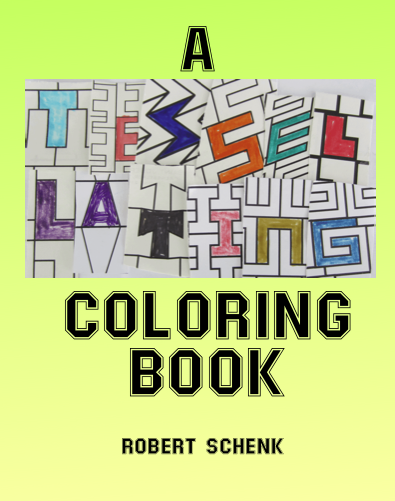
So far there is no evidence that this was a worthwhile endeavor.

A second way of utilizing these tessellation patterns is to make typefaces from them. The Tescellations fonts are discussed here. A second set of two fonts, the TessieDingies package, has recently been released on myfonts.com. One font is devoted to patterns that are abstract.
 The other contains patterns that are composed of tessellations forms that resemble birds, animals, vehicles, tools, and other objects from the real world.
 The typefaces make creating tessellation patterns very easy. Each pattern is on one key, so one simply makes several lines of the same character, formats in one of the TessieDingies fonts, and makes sure that the line spacing (the leading) is equal to the font size. When you do, you can get patterns like those above.